
Table of Contents
Quick Summary:
Liquid cultures offer many advantages over spore syringes, including faster colonisation and a longer shelf-life. So if fast growing speeds is what you’re after, a liquid culture is the way to go.
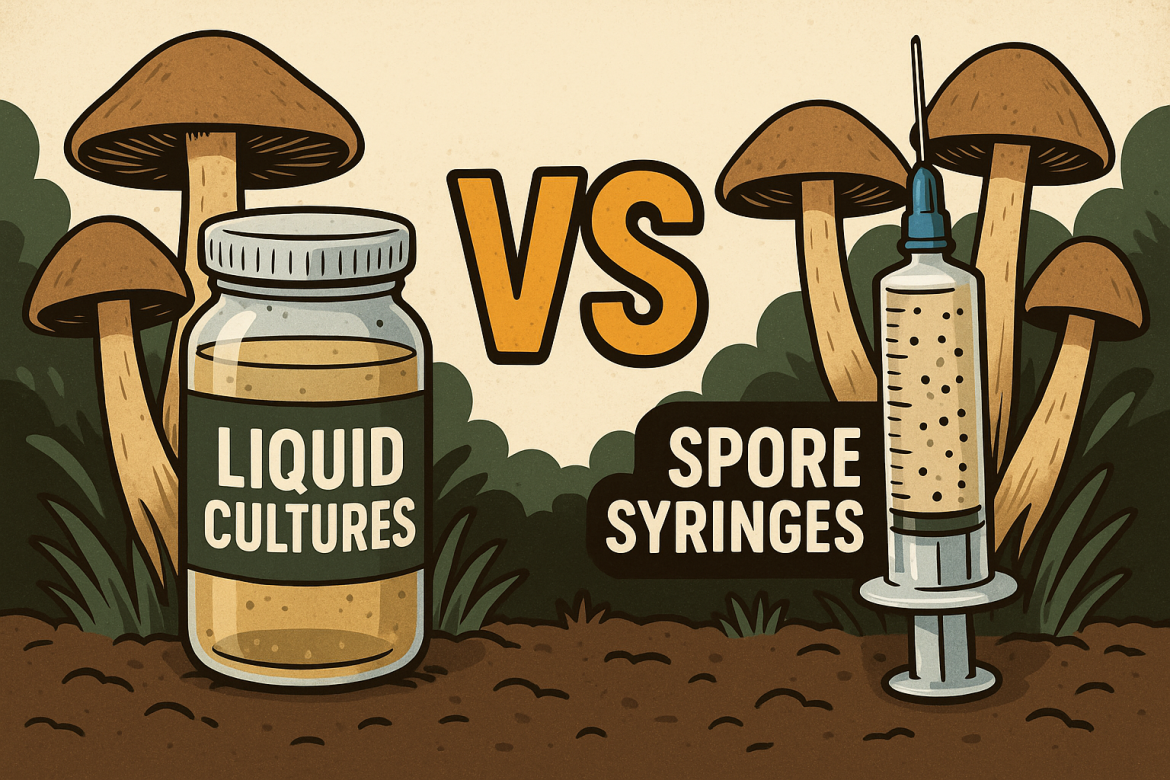
For those just starting their journey in mushroom cultivation, you may have come across the terms liquid cultures and spore syringes. At first glance, they may look similar because both come in syringes and are used to inoculate substrates, but what is inside and how they perform are completely different.
Knowing the difference between these two cultivation tools, you can get a better understanding of what the right starting point is for growing mushrooms at home yourself. So let’s show you what each one is, how they are used, and the pros and cons to help you decide which is best for your cultivation goals.
What Is a Spore Syringe?
A spore syringe is one of the simplest and most accessible ways to begin a mushroom grow. Inside the syringe are millions of microscopic spores that are essentially the seeds of mushrooms. These are suspended in sterile distilled water. You may notice tiny flecks floating in the liquid, which are clusters of spores ready to germinate.
When you inject a spore syringe into a suitable substrate like agar or grain, the spores will first need to germinate and form mycelium, which is the thread-like network that eventually produces mushrooms.
Because every spore carries a unique genetic makeup, the spore syringe contains tens of thousands of potential mushroom lineages. This means your grow can produce a wide diversity of mushrooms. For this reason, working with spore syringes can mean you never quite know what you’ll get; the options are potentially endless!
The Advantages of Spore Syringes
- Longer shelf life, as they can last between six months to a full year when refrigerated and sealed.
- As they are simple to produce and widely available, they are often more affordable and easier to source than liquid cultures.
- Genetic diversity, as each syringe contains countless unique spores, and offers the opportunity to discover new desirable strains if you plan to isolate cultures later.
- It’s a perfect starting point for beginners, as they can experiment with germination and contamination prevention techniques at a low cost.
Disadvantages of Spore Syringes
- The spores need to germinate before mycelium can begin spreading through the substrate, which delays colonisation and increases opportunities for contamination.
- As each grow contains mixed genetics, results can vary in growth rate, potency, and yield.
- For bulk or commercial setups, genetic inconsistency can mean unreliable results over time.
What Is a Liquid Culture?
Liquid culture is, in essence, one step ahead of the spore syringe. Instead of the spores being in water, liquid culture contains live mycelium growing in a nutrient-rich liquid, typically a sugar or honey solution. The mycelium is already formed, meaning it can start colonising substrates almost immediately after the process of inoculation.
Using the analogy of spores as seeds, liquid culture is like a young plant cutting ready to root and grow. Liquid culture spreads quickly when it is introduced to a substrate and often shows visible colonisation within just a few days.
For experienced growers, the speed and reliability make liquid culture a very powerful tool for producing consistent results, and paired with a mushroom grow kit can really yield amazing results quickly.
The Advantages of Liquid Cultures
- Since the spores have already germinated, liquid cultures begin to grow right away and often colonise a substrate within a short time period, typically one to three weeks.
- Well-prepared liquid cultures are typically monocultures and are descendants of a single strong strain chosen for ideal traits such as yield and growth speed, so this ensures that you get consistent results every time you inoculate because of their genetic uniformity.
- Because the active mycelium quickly claims the substrate, this reduces the risk of contamination throughout the process and speeds up your timeline to the first flush, resulting in a high success rate.
- If you are looking to scale up a strain quickly, growers can easily expand a reliable liquid culture by transferring it to additional jars or bags.
The Disadvantages of Liquid Cultures
- Liquid cultures typically last up to six months under refrigeration. As it’s a living culture, it requires occasional agitation to keep oxygen circulating and maintain its viability.
- If a liquid culture becomes contaminated, it can spread unwanted bacteria or mould very quickly, and this is why it is critical to purchase your liquid cultures from reputable suppliers that have high strain quality and can verify their sterility.
- While consistency can be an advantage, liquid cultures also mean that you can miss out on the diverse genetics that spore syringes offer.
Liquid Cultures vs. Spores – Comparison Table
| Feature | Spore Syringe | Liquid Culture |
|---|---|---|
| Contains | Spores in sterile water | Live mycelium in nutrient liquid |
| Growth Speed | Slow (must germinate first) | Fast (already active) |
| Genetics | Highly variable | Consistent (single strain) |
| Shelf Life | 6–12 months | 3–6 months |
| Contamination Risk | Moderate to high | Low (if sterile) |
| Best For | Beginners, experimentation | Experienced growers, consistent yields |
Best Inoculation Method & Grow System
| Grow System / Method | Best Inoculation Option(s) | Notes / Considerations |
|---|---|---|
| Inject-and-Forget Grow Bag / All-in-One Bag | Liquid Culture (preferred), Spore Syringe (alternative) | Because the bag is sealed and you typically won’t open it or mix once inoculated, you want something that colonises quickly and dominantly. Liquid culture gives you that “fast takeover” advantage. Spore syringes can work, but the slower germination stage gives contamination more opportunity. |
| Monotub / Bulk Substrate (spawn → bulk, or “grain spawn + mixing” in monotub) | Liquid Culture (best), Spore Syringe (if experienced) | For bulk grows, consistency, speed, and low contamination are critical. A pure, strong liquid culture can be used to inoculate grain spawn jars (or spawn bags), which then get mixed into bulk substrate in a monotub. A spore syringe could be used, but the variability and slower growth might lead to uneven colonisation or more contamination. |
| Spawn Jars / Grain Colonisation | Both can work, but Liquid Culture often gives faster, more reliable results | If you are inoculating sterile grain jars before spawning out, liquid culture helps you get mycelial colonisation faster. That said, hobbyists often start with spore syringes for small test jars, then isolate to liquid cultures. |
| Small Bags, Test Runs, Microgrows | Spore Syringe (especially for experimentation), or Liquid Culture | If you are just trialling a strain or doing a small run, the simplicity of spore syringes is appealing. But even in small runs, liquid culture gives you the advantage of faster colonisation. |
In short: for sealed bags or bulk systems you really want a strong culture that colonises fast (liquid culture wins), but spore syringes remain useful for experimentation, strain discovery, or low-risk small runs.
NOTE: Please remember that magic mushroom spores are illegal to inoculate / grow in the UK and are sold strictly for the purposes of microscopy study, unless purchased in a country where growing magic mushrooms is legal, in which case the methods above can be taken into consideration.
Which Should You Choose?
The choice between liquid cultures and spores will depend on you, namely, your goals and experience level.
If you’re just starting out and you want to enjoy the experimental side of mushroom growing, spore syringes are an excellent option. But if you value predictability, efficiency, and speed, liquid culture is one step ahead and is particularly beneficial once you’ve mastered sterile inoculation and want to maintain high-quality strains over time.
Whichever path you take, sourcing pure, contaminant-free materials from trustworthy suppliers will ensure you set up your grows for success.

Leave a comment