
Table of Contents
The term “magic mushrooms” is a catch-all phrase referring to specific species of mushrooms containing the psychoactive compounds psilocybin and psilocin. Unlike the substances found in most regular mushrooms, these chemicals actively change brain states and lead to profound alternations in consciousness.
Many people who take magic mushrooms report feelings of euphoria, vivid hallucinations and profound spiritual insights. Consequently, it is often seen as a shortcut to spiritual insight, with mushroom-takers often being called “psychonauts” in reference to their out-of-body and other-worldly experiences.
Counting them all up, there are actually more than 200 species of psychoactive mushrooms belonging to the Psilocybe genus, and cultures across the globe have been using them for millennia. Common examples might include Gymnopilus, Psilocybe mexicana, and psilocybe cubensis. The only continent where they don’t grow wild is Antarctica.
Where Do Magic Mushrooms Come From?
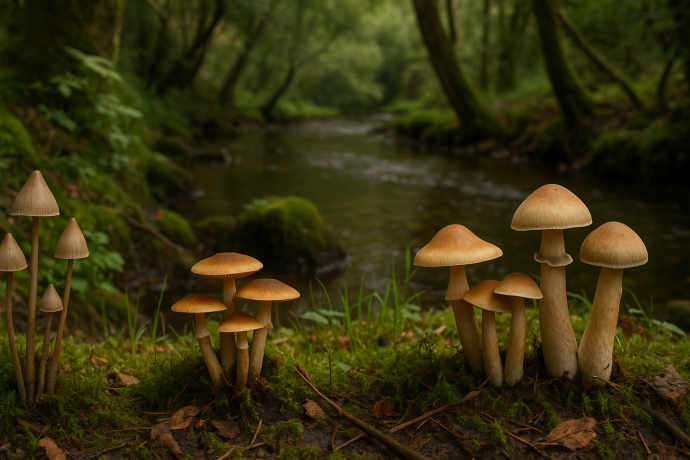
Magic mushrooms are a genus of mushrooms that are found across the globe, not in a single location. Consequently, researchers aren’t entirely sure where they originated. They like to grow in moist, damp conditions, like other mushrooms.
The most likely origin is somewhere in subtropical regions, like central South America or parts of Africa. Over time, they adapted and were able to thrive in more locations closer to the poles.
Researchers think that people began using magic mushrooms several thousand years ago, most likely in Central and South America. Archaeological evidence seems to indicate ceremonial mushroom preparation, but the true date of the first usage remains mysterious.
Over time, magic mushrooms came to grow in many more regions of the globe. Some species spread into North America, particularly the Pacific Northwest and British Columbia, known for their psychedelic communities during the mid and late twentieth centuries.
Europe also saw the spread of these mushrooms. Liberty caps can grow in Britain, with similar species in the Netherlands and Eastern Europe.
In Asia, magic mushrooms grow in countries as varied as Thailand, Vietnam, Japan and India. This range indicates the strength of the species and its adaptability.
Even Oceania now has magic mushrooms growing wild. They can be found in both Australia and New Zealand.
The History Of Magic Mushrooms
The history of magic mushrooms is fascinating and reveals how they have been a part of the human experience for almost as long as human civilization has been around. Mainstream thinkers believe people started using psilocybin in Mesoamerican cultures, like the Aztecs and Zapotec, as far back as 3,000 BC, the same time as the construction of the Great Pyramid of Giza.
Evidence for this comes from various stone mushroom carvings found in the area. People seemed to venerate magic mushrooms and sought for their mind-altering properties. They were viewed as a kind of “flesh of the gods” because of their unique ability to transform human consciousness.
During the 1500s, Spanish explorers and conquistadors recorded the indigenous use of magic mushrooms in their history manuals. When it found out, the Catholic church condemned the practice, but many sailors and Europeans tried the mushrooms anyway and saw for themselves why ancient cultures were so enamoured by them.
Centuries later during the 1950s, J.P. Morgan VP, R. Gordon Wasson, began spreading the lost knowledge of magic mushrooms in the West again. In 1955, he traveled to Oaxaca in Mexico to take part in a psilocybin ritual with Mazatec people. He later wrote an article for Life Magazine documenting his experiences entitled Seeking the Magic Mushroom, telling readers about the mushrooms and how they had affected him.
Wasson later sent Albert Hoffman, the scientist who discovered LSD, a sample of mushrooms to identify the active ingredient. Hoffman confirmed the presence of psilocybin in 1958, beginning a movement that would last decades.
During the 1960s, magic mushrooms became a centrepiece of the counterculture in Britain, the US, and Canada. Hippies took mushrooms to festivals with them, using them to go on joint psychological adventures with their friends.
Various psilocybin projects were started around this time, including by the CIA, which wanted to use them to explore the spirit world. The agency believed people taking them might be able to access some other realm, due to the strange similarity of hallucination reports.
The U.S. Controlled Substances Act classified psilocybin as a Schedule I narcotic and banned it during the 1970s. Many people went to jail for using the drug.
However, things began to change around the year 2000. During this period, psychedelics saw something of a renaissance as Westerners attempted to escape the twin evils of materialism and nihilism. Magic mushrooms were viewed as a portal to a realm beyond the banality of a mechanistic world.
Finally, some U.S. cities began to decriminalise psychedelics in the 2020s, sparking a global movement. Other countries have been slower to follow, but change is happening.
Cultural & Historical Use
The cultural and historical use of magic mushrooms varies wildly, depending on location. Ancient Aztecs called these mushrooms “teonanácatl” and used them in numerous ceremonies, including healing, divination, and coronation. While evidence is thin, it’s clear the culture venerated mushrooms sufficiently to include them as critical elements in the most important parts of community and public life.
The Mazatec (from a different part of Mexico), also used them in healing rituals. Shamen, called curanderas, would attempt to alleviate the sickness of their suffering and connect people to the spirit world where they would find peace and joy.
Debate rages as to whether magic mushrooms were a part of ancient Indian experience. The Rigveda text may refer to them as Soma, but this remains quite unclear.
Siberian tribes would also have had access to psilocybin-like species. Called Amanita muscaria, these may have seen pre-modern usage though, again, the evidence is circumstantial and sketchy.
The real use of magic mushrooms began to explode, as discussed, during the 1960s and 1970s countercultural revolution. Influential individuals, like Terence McKenna and his Cambridge-educated friend, Rupert Sheldrake, led the movement from a spiritual perspective, using it to bolster their case against 19th-century billiard-ball materialism. According to these thinkers and practitioners, the spirit world was alive and well, and with magic mushrooms, it was a place ordinary people could go.
American psychologist Timothy Leary also amplified this movement. He believed that people could use magic mushrooms as a hybrid between spiritual practice and therapy, assisting them in dealing with the challenges of the modern world.
Legal Status of Magic Mushrooms in 2025
The legal status of magic mushrooms varies quite substantially, depending on where you are.
Only Jamaica has no restrictions. The Netherlands is nearly restriction-free, but limited to truffles, not mushrooms.
In the U.S., several cities have decriminalised magic mushrooms, including Seattle, Detroit, Oregon for therapeutic use, Colorado for personal use, Santa Cruz and Ann Arbor. In Canada, it’s legal to use magic mushrooms in Vancouver, and some citizens can access it elsewhere for therapeutic reasons.
Even so, the use of magic mushrooms remains illegal in most countries, including Britain. Germany, Japan, China, Argentina and even Paraguay all ban it.
Research-Backed Benefits of Psilocybin
Despite the bans, substantial research suggests that psilocybin has medical benefits. Like other natural compounds, it seems to have a role to play.
The strongest evidence is for the treatment of anxiety and depression. Psilocybin is effective in cases that have been resistant to other forms of treatment.
There’s also some evidence that magic mushrooms may help reduce addiction to smoking and alcohol. According to Johns Hopkins, 80% of psilocybin users can stop substance abuse after six months.
Finally, there’s emerging evidence that psilocybin may be profitable for PTSD patients. Currently, a number of studies are under way to determine whether magic mushroom use is feasible in these cases.
Whether magic mushrooms can assist with cluster headaches, intellectual pursuits, and all-around mindfulness remains unclear. Some evidence exists, but more work needs to be done.
What Are The Risks?
So, with all that said, what are the risks of using magic mushrooms?
The primary concern is going on a “bad trip.” While most people enjoy their experience of the drug, some have negative experiences, like anxiety or paranoia.
There are also physical side effects like increased heart rate and dilated pupils. These subside with time, but could potentially be dangerous.
The good news is that overdosing on psilocybin is extremely rare. The mushrooms have low toxicity.
Summary & Conclusions
So, what do we think of magic mushrooms overall?
The FDA’s landmark decision to classify psilocybin as a breakthrough therapy for depression has changed the conversation around the drug. Now, more countries are opening up and allowing citizens to use the substance.
Furthermore, a growing number of people are experiencing a sense of the divine because of it. Magic mushrooms are facilitating an escape from the trap of secular modernity and putting people back in touch with the spirit world, something that humans took for granted centuries ago.
Finally, a growing body of medical research suggests that psilocybin and magic mushrooms may be beneficial for people with specific conditions, like depression. Evidence is still being gathered, but it’s promising.

Leave a comment